How to Make an Eye-Catching Checkerboard Cake for Any Occasion
There’s nothing quite like the joy and excitement of a child’s birthday. Recently, we celebrated Melinda’s son, Sawyer’s 4th birthday, and it was a whirlwind of fun and creativity. Sawyer, a budding race car enthusiast, requested a thrilling race car theme for his party. Naturally, we went all out with decorations – from checkered flags and banners to tablecloths, every detail screamed “start your engines!” With such a prominent checkerboard pattern throughout the party décor, we knew one thing was essential for the dessert table: a show-stopping checkerboard cake. This visually stunning cake, with its alternating colors forming a perfect grid, was the ideal centerpiece to tie the entire theme together.
Many home bakers might view a checkerboard cake as an intimidating project, something best left to professional patissiers. However, we’re here to demystify the process and show you that creating this impressive dessert is surprisingly simple and incredibly rewarding. If you’ve ever dreamt of serving a cake that elicits gasps of delight when sliced, then this guide is for you. We’ll walk you through each step, from baking the perfect layers to mastering the seamless frosting technique, ensuring your checkerboard cake is both delicious and a feast for the eyes.
The Allure of the Checkerboard Cake: More Than Just a Dessert
The checkerboard cake isn’t just a cake; it’s a conversation starter. Its distinctive pattern adds a touch of sophistication and whimsy to any celebration, making it perfect for birthdays, anniversaries, or even casual get-togethers where you want to impress. Beyond its aesthetic appeal, the beauty of this cake lies in its versatility. You can customize the cake flavors and colors to match any theme – think vibrant rainbow patterns for a playful birthday, classic black and white for a sophisticated event, or even seasonal colors for holidays. For Sawyer’s race car party, the black and white checkerboard was a natural fit, perfectly complementing the racing motif.
Historically, checkerboard cakes have been around for generations, a testament to their enduring charm. While they might look complex, the technique relies on a clever method of cutting and reassembling cake layers, which, once understood, is quite straightforward. The key is in precision and patience, two ingredients that transform simple cake layers into a work of edible art. Let’s dive into how you can create your very own masterpiece.
Gather Your Baking Essentials: From Layers to Levelers
To embark on your checkerboard cake journey, you’ll need a few essential tools and ingredients. We opted for a two-layer, 6-inch cake, but these steps are adaptable for any size or number of layers. The critical component is having two distinct cake colors. For our cake, we chose a classic combination of rich devil’s food cake and bright white cake, creating a striking contrast that truly popped.
What You’ll Need:
- Cake Mixes (or your favorite recipes): Two boxes of contrasting cake mixes (e.g., chocolate and vanilla, or two different colored mixes). Each box typically yields two 8-inch layers, so for a 6-inch cake, you’ll have extra batter – perfect for cupcakes or cake balls!
- Cake Pans: Two 6-inch round cake pans (or your preferred size).
- Baking Essentials: Mixing bowls, spatulas, parchment paper, cooking spray, and oven.
- Cake Leveler or Long Serrated Knife: Essential for creating perfectly flat cake layers for stable stacking.
- Round Cutters: Various sizes of round objects for cutting rings (e.g., cookie cutters, different sized bowls, or even a custom cardboard template). We’ll explain how to select these.
- Angled Spatula: For spreading frosting smoothly.
- Viva Paper Towels: The brand is crucial here; Viva paper towels lack quilting, providing a perfectly smooth surface for frosting.
- Crusting Buttercream Frosting: The star of our smooth frosting technique.
- Hot Water: For the smoothing method.
- Optional: Wilton icing smoother, rotating cake stand.
Step-by-Step Guide to Crafting Your Checkerboard Cake
1. Bake and Cool Your Cake Layers
Begin by baking your cake layers according to your chosen recipe or cake mix instructions. Remember to prepare two distinct colors. For our 6-inch cake, one box of mix usually yields two layers, so with two colors, we ended up with four 6-inch layers. You can use two of these for your checkerboard cake and freeze the remaining layers for future use, or if you prefer a taller, more dramatic cake, you can create a four-layer checkerboard cake by repeating the pattern on all layers. Ensure your cakes are completely cooled before proceeding. Warm cakes are prone to crumbling and won’t hold their shape during cutting and assembly.
2. Level Your Cake Layers for Perfection
Once cooled, it’s time to level your cakes. This step is crucial for creating a stable, even cake that stacks beautifully and looks professional. If you have a Wilton cake leveler, this task is incredibly easy. Simply adjust it to your desired height and slice off the domed top. If you don’t have a leveler, a long, sharp serrated knife works just as well. Place the cake on a flat surface, hold the knife parallel to the counter, and carefully saw off the rounded top until you achieve a perfectly flat surface. Repeat for all cake layers you intend to use.
3. Create the Iconic Checkerboard Pattern
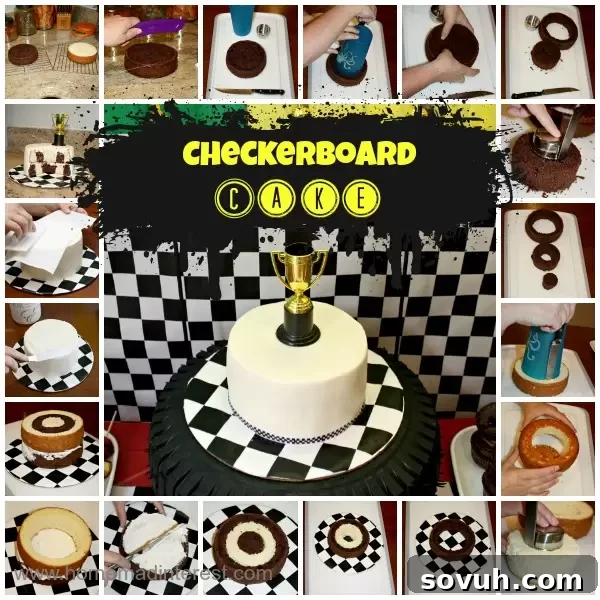
This is where the magic happens! To create the checkerboard pattern, you’ll need to cut each leveled cake layer into concentric rings. You’ll need at least two, preferably three, different sized round cutters. Look around your kitchen for suitable objects: different sized cookie cutters, various bowls, or even clean tin cans can work. If you can’t find appropriate sizes, you can easily cut circles from cardboard to use as templates. The goal is to have cutters that create rings with even widths.
Here’s how to do it:
- Take one of your leveled cake layers. Place the largest circular cutter (or template) in the center of the cake. Using a sharp knife, carefully cut around the inside edge of the cutter, going all the way through the cake.
- Once the outer ring is cut, remove the largest cutter. Now, place the next smaller circular cutter in the center of the cake, aligning it perfectly with the previously cut circle. Cut around this, again going all the way through.
- Repeat with the smallest cutter for the very center. You should now have three concentric rings (an outer ring, a middle ring, and a center core) from one cake layer. Gently separate these pieces.
- Repeat this entire cutting process for the second cake layer of a contrasting color.
4. Assemble the Checkerboard Layers
Now comes the exciting part: reassembling the rings to form the checkerboard pattern. The key here is to alternate colors. For your first layer, choose a color for the outermost ring. For example, if you start with a white outer ring, you’ll then place a chocolate middle ring inside it, and finally, a white center core. This creates the alternating pattern. Do the opposite for your second layer (e.g., chocolate outer, white middle, chocolate center).
Carefully transfer your first assembled checkerboard layer to your cake board or serving plate. Spread a thin, even layer of your chosen frosting over the top of this first layer. This not only adds flavor but also acts as “glue” to hold the layers together. Now, gently place your second assembled checkerboard layer on top, ensuring the colors alternate from the layer below. For instance, if the first layer had a white center, the second layer should have a chocolate center directly above it. This ensures the checkerboard pattern continues vertically through the cake.
5. Apply a Crumb Coat
Before applying your final, smooth frosting, it’s highly recommended to apply a thin crumb coat. This is a very thin layer of frosting that traps any loose crumbs, preventing them from mixing into your final, pristine outer layer. Spread a thin amount of frosting over the entire cake, top and sides. Once applied, chill the cake in the refrigerator for 15-20 minutes, or until the crumb coat is firm to the touch.
6. The Art of Smooth Frosting: Viva Paper Towel Method
Melinda specifically requested a perfectly smooth white frosting that looked elegant and modern, without the use of fondant. Fondant, while offering a pristine finish, often falls short on taste for many. Our secret weapon for achieving a flawless, fondant-like finish with delicious buttercream is the “Viva Paper Towel Smoothing Method.” This technique requires a crusting buttercream frosting, which firms up slightly when exposed to air, preventing it from sticking to the paper towel during smoothing. It demands a little patience and time, but the results are absolutely worth it!
Crusting Buttercream Frosting Recipe
Ingredients
- 1 stick (1/2 cup) unsalted Butter, softened
- 1 1/2 cups Shortening (high-quality, all-vegetable shortening recommended for whiteness)
- 1 pound (approx. 4 cups) Confectioners’ Sugar, sifted
- 1/3 cup Water (start with less and add slowly)
- Optional: 1-2 teaspoons vanilla extract or other flavoring
Instructions
- In a large mixing bowl, cream together the softened butter, shortening, and sifted confectioners’ sugar. Start on low speed to prevent a cloud of sugar, then increase to medium-high and beat until light and fluffy.
- Gradually add the water, one tablespoon at a time, beating well after each addition. Continue until you reach your desired consistency. For smoothing, you’ll want a medium consistency that is easy to spread but holds its shape. If using extract, add it with the last bit of water.
- Beat on high speed for a few minutes until the frosting is very smooth and airy.
Nutrition
Nutrition Disclaimer: We are not certified nutritionists. Nutrition facts are an estimate and are provided as a courtesy. They are generated by an online API which recognizes ingredient names and amounts and makes calculations based on the serving size. Results may vary.
- Serving Size: 2 tbsp
- Calories: 228 kcal
- Carbohydrates: 28g
- Fat: 12g
- Saturated Fat: 7g
- Polyunsaturated Fat: 1g
- Monounsaturated Fat: 4g
- Cholesterol: 5mg
- Sodium: 14mg
- Sugar: 27g
- Vitamin A: 100IU
Course: Dessert
Cuisine: American
Print Recipe
Executing the Viva Paper Towel Method:
Once your crumb coat is firm, apply a generous, even layer of your crusting buttercream over the entire cake. Don’t worry about it being perfectly smooth at this stage; focus on getting an even coating. Use an angled spatula for this. Allow the cake to sit for 15-30 minutes, or until the buttercream has formed a light crust.
Now, dip a clean angled spatula into really hot water (we use water from our Keurig for convenience) and wipe it dry. Place a sheet of Viva paper towel (remember, it must be the quilting-free kind!) gently over a section of the crusted frosting. With your hot, dry spatula or a Wilton icing smoother (or even just your clean hand), gently rub over the paper towel in smooth, even strokes. The heat from the spatula combined with the smoothness of the Viva paper towel will beautifully iron out any imperfections in the buttercream, leaving a silky-smooth finish. Lift the paper towel carefully, and repeat this process, section by section, all around the cake, re-heating and drying your spatula as needed. Take your time, and you’ll be amazed at the professional results. For an incredibly detailed visual guide, we highly recommend checking out this tutorial on Cake Central; it explains the method perfectly.
In the end, you’ll have a perfectly smooth frosting that rivals fondant in appearance but delights with its authentic, delicious buttercream taste!
Tips for Checkerboard Cake Success
- Chill Your Cakes: Cold cake layers are much easier to handle, level, and cut without crumbling. Pop them in the refrigerator for at least 30 minutes before cutting.
- Measure Your Cutters: Ensure your circular cutters or templates are proportionally sized. Even gaps between the rings will give a more uniform checkerboard pattern.
- Gentle Handling: The cake rings can be delicate. Use a thin spatula or your hands to carefully transfer and assemble them.
- Even Frosting Between Layers: Don’t skimp on the frosting between layers, but also don’t overdo it. An even layer is key for stability and to prevent bulging.
- Practice Patience with Smoothing: The Viva method takes a bit of practice. Don’t be discouraged if your first attempt isn’t perfect. It gets easier with each try!
- Sturdy Buttercream: A firm, crusting buttercream is essential for both the structure of the cake and the smoothing technique. Avoid very soft or loose frostings.
Customize Your Checkerboard Cake: Endless Possibilities
While the classic chocolate and vanilla checkerboard is always a hit, don’t be afraid to experiment with different flavors and colors to make your cake truly unique:
- Flavor Combinations: Try red velvet and cream cheese swirl, lemon and blueberry, or even a fun strawberry and vanilla.
- Vibrant Colors: Use gel food coloring to dye your cake batters bright colors for a rainbow checkerboard effect, perfect for children’s parties or Pride celebrations.
- Themed Decorations: Once frosted, the exterior of your cake is a blank canvas. Add sprinkles, edible glitter, fresh fruit, or fondant decorations that match your party theme. For a race car theme, small toy cars or edible checkered flag toppers would be fantastic.
- Different Cake Sizes: While we used a 6-inch cake, the technique scales up or down. A larger 8 or 9-inch cake will have wider rings, while smaller cakes can be incredibly charming for individual servings or mini celebrations.
Conclusion: A Dazzling Dessert That’s Easier Than You Think
The checkerboard cake was an absolute hit at Sawyer’s race car birthday party. Not only did it look incredible, perfectly aligning with the theme, but it was also incredibly delicious, earning rave reviews from all our guests. The initial hesitation about tackling such an intricate-looking cake quickly evaporated once we saw how straightforward the process truly was. It proves that with a little guidance and patience, anyone can create a professional-looking and delectable dessert that will be remembered long after the last slice is gone.
So, next time you’re planning a special occasion, consider making a checkerboard cake. It’s a fantastic way to elevate your baking skills and add a truly memorable element to your celebration. We hope this detailed guide empowers you to try this delightful creation in your own kitchen. And speaking of the party, don’t forget to check back on Saturday for our complete post on Sawyer’s epic race car birthday party and all the fun, vibrant details that brought it to life!